

Home  >  Blog  >  Lifestyle & living
Water, Power and Sustainability: The Due Diligence Bangalore Buyers Overlook
LIFESTYLE & LIVING

Water, Power and Sustainability: The Due Diligence Bangalore Buyers Overlook

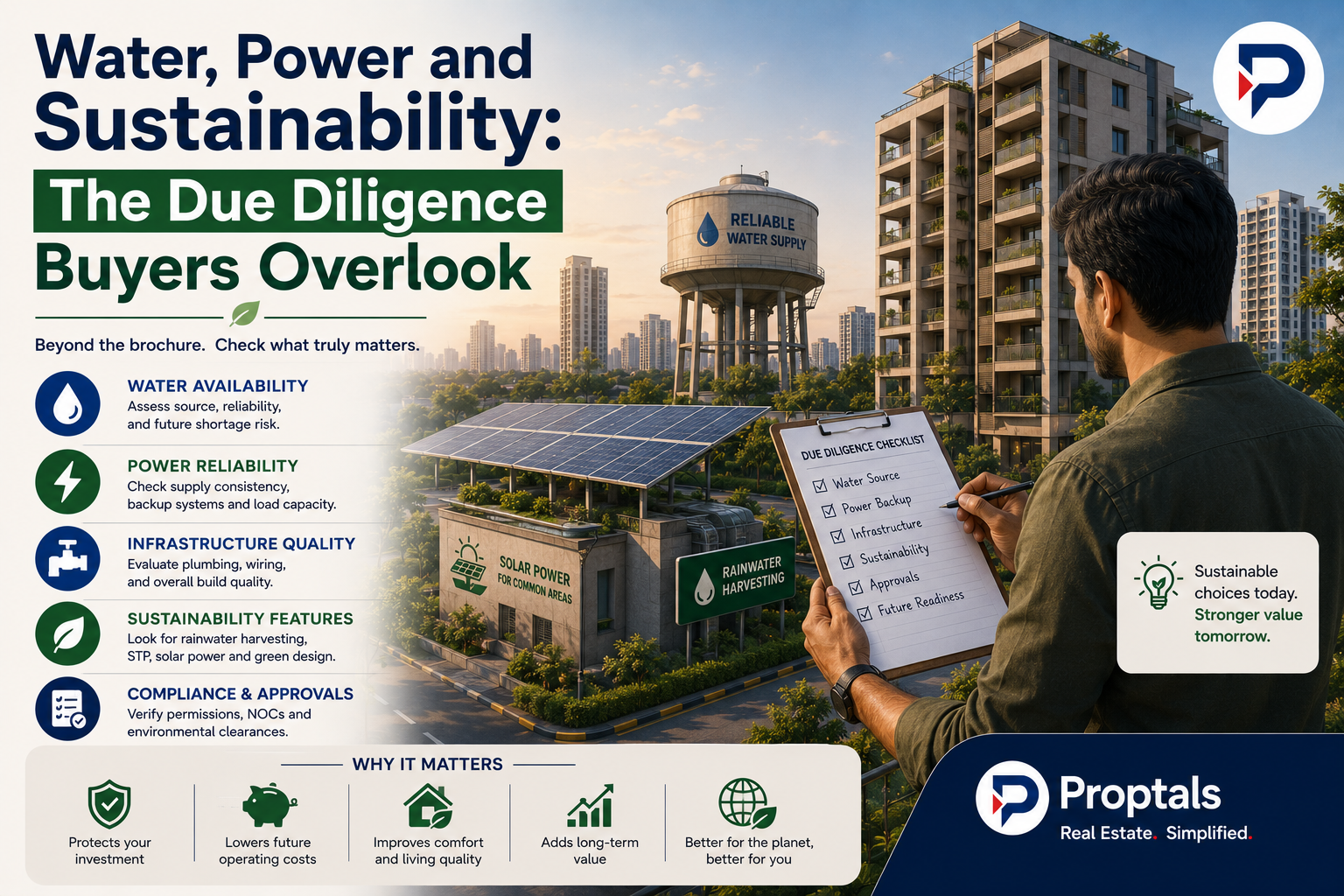
After recent dry summers, water has become the first question smart Bengaluru buyers and tenants ask. How to check a property's water source, sewage treatment, rainwater harvesting, power backup and running costs before you buy.

Tariq Sallam
By Tariq Sallam, founder of Proptals
Jun 23, 2026 · Updated Oct 1, 2026
5 min read

KEY TAKEAWAYS

  • Ask where the water comes from: piped Cauvery supply, borewells, tankers or a mix, and what happened in the last dry summer.
  • A working sewage treatment plant that recycles water for flushing and gardens cuts tanker dependence and monthly costs.
  • Rainwater harvesting is mandatory for larger sites under BWSSB rules. Ask to see it, and when it was last serviced.
  • Confirm the power backup in kW for your unit, and whether it covers air conditioning.
  • Utilities show up in your maintenance bill every month and in your resale value for years. Check them before the finishes.

In 2024, much of Bengaluru went through a severe water shortage. Borewells dried up, tanker prices rose sharply, and some apartment communities rationed water. Buyers and tenants who lived through it now ask about water before they ask about the clubhouse.

Since then, supply has improved in many areas, including the Cauvery Stage V scheme that extended piped water to more of the city's outer areas. But supply still varies hugely from one building to the next. Here is how to check a property's water, power and running costs properly.

Water: The Questions to Ask

1. What is the primary source?

There are three main sources in Bengaluru: piped supply from BWSSB, borewells on the property, and private tankers. Most large apartment communities use a mix. Ask what share each provides in a normal month and in a dry summer.

  • Piped BWSSB (Cauvery) supply is the most reliable and usually the cheapest. Check whether the building actually has a connection, not just that the area is covered.
  • Borewells can be good in some areas and unreliable in others. Ask how many, how deep, and whether any dried up recently.
  • Tanker dependence is the most expensive and least reliable. Heavy tanker use is a red flag.

2. What does the association spend on water?

Ask the association or facility manager for last year's water expenses, especially tanker costs in the summer months. This tells you more than any brochure.

3. Is there a working sewage treatment plant?

Large apartment projects are required to treat their sewage. A well-run STP recycles treated water for flushing and landscaping, which substantially reduces fresh water demand. Ask to see it running, not just installed.

4. Is rainwater harvesting in place, and maintained?

BWSSB requires rainwater harvesting for larger sites, and non-compliance can attract penalties. Many projects have the pits and pipes but neglect maintenance. Ask to see the recharge pits and when they were last cleaned.

Power: The Questions to Ask

  • Sanctioned load for your unit from BESCOM, and whether it is enough for your appliances and air conditioning.
  • Power backup in kW per unit, and what it covers. Many buyers discover after moving in that backup does not run ACs or geysers.
  • Common-area backup for lifts, pumps, STP and security.
  • Rooftop solar for common areas, which reduces maintenance charges year after year.
  • EV charging: provision in the parking for charging points, which is quickly becoming a resale factor.

Waste, Greenery and Running Costs

Projects that manage waste well, by segregating at source and composting wet waste on site, tend to be well managed overall. Bengaluru's civic authorities require bulk waste generators to process their waste, so a functioning system also avoids compliance problems.

All of this shows up in your monthly maintenance bill. Ask for the current maintenance charge per square foot, what it covers, and how much it has increased in the last two years. A building with high charges and poor services is a hard sell later.

A Site Visit Checklist

CheckWhat good looks like
Water sourceBWSSB connection plus borewell backup; little or no routine tanker use
Summer historyNo rationing in the last dry season; association can show records
STPRunning, with treated water reused for flushing and gardens
Rainwater harvestingRecharge pits present, clean and recently serviced
Power backupClear kW per unit; covers essential loads you need
Solar and efficiencySolar for common areas; LED lighting
WasteSegregation and on-site composting working
Maintenance chargesReasonable for the services; transparent accounts

For Independent Houses and Villas

If you are buying an independent house or a villa in a plotted development, the same questions apply but you carry them yourself. Check the BWSSB connection status, the borewell's yield and depth, the sump and overhead tank capacity, the rainwater harvesting system, and the sanctioned power load. In panchayat areas outside BWSSB coverage, ask how water is supplied and at what cost.

Questions to Ask Current Residents

Residents will tell you what brochures will not. If you can, speak to two or three people living in the building:

  1. Did you face water shortages last summer? For how long?
  2. How much has maintenance gone up in the last two years, and why?
  3. Does power backup cover what was promised?
  4. How responsive is the association or facility manager?
  5. Would you buy here again?

Running Costs: An Example

Utilities and services show up in maintenance charges. In a well-run building, the STP and rainwater harvesting reduce water costs, solar reduces common-area power bills, and good waste management avoids penalties. In a poorly run building, tanker bills, diesel for generators and emergency repairs push charges up year after year.

When comparing two similar flats, ask each association for last year's income and expenditure statement. The difference in running costs over ten years can be larger than the difference in price.

What Developers Should Provide in New Projects

  • A clear plan for water supply: BWSSB connection status or timeline, borewells, storage capacity.
  • A sewage treatment plant sized for full occupancy, with treated water reuse.
  • Rainwater harvesting as required by BWSSB rules.
  • Power backup specified in kW per unit, and a sanctioned load from BESCOM.
  • Provision for solar and EV charging.
  • Waste management facilities for segregation and composting.

Ask for these in writing, and check the RERA filing for what has actually been committed.

Why This Affects Resale

Buyers and tenants talk to each other. A building known for water problems rents more slowly and sells at a discount, however good the finishes. A building known for reliable water, sensible maintenance charges and a well-run association holds its value through every cycle. When you buy, you are buying the building's reputation along with your flat.

Frequently Asked Questions

How do I check if a Bangalore apartment has a water problem?

Ask the association for the water source mix and last summer's tanker spend, talk to current residents, and check whether the building has a BWSSB connection and a working sewage treatment plant.

Is rainwater harvesting mandatory in Bangalore?

Yes, for larger sites under BWSSB rules. Check the current size threshold with BWSSB, and make sure the system is maintained, not just installed.

What is Cauvery Stage V?

A BWSSB water supply project that extended piped Cauvery water to many of Bengaluru's outer areas. Coverage of an area does not guarantee a specific building is connected, so always check.

How much power backup should an apartment have?

It depends on your needs. Ask for the kW allotted to your unit and what it can run. Many buyers want backup that covers at least lights, fans, refrigerator and Wi-Fi, and ideally one AC.

Do water issues affect property value?

Yes. Buildings with unreliable water rent more slowly and tend to sell at a discount. Reliable utilities support long-term value.

Ask the utility questions before the aesthetic ones. A home that runs reliably through a Bengaluru summer holds its value in every market. If you would like me to check a specific building before you commit, message me on WhatsApp.

Sources

Last updated Oct 1, 2026. Figures and rules change; check current details with a professional before you act.

Share this post:
Tariq Sallam, Founder of Proptals
ABOUT THE AUTHOR
Tariq Sallam
Founder, Proptals · Karnataka RERA registered agent

Tariq has advised buyers, sellers, landlords, landowners and developers in Bangalore since 2004. He writes about what he sees on site visits, in negotiations and at registration offices.

ASK TARIQ ON WHATSAPP
Water, Power and Sustainability: The Due Diligence Bangalore Buyers Overlook | Proptals Blog
Home  >  Blog  >  Lifestyle & living
Water, Power and Sustainability: The Due Diligence Bangalore Buyers Overlook
LIFESTYLE & LIVING

Water, Power and Sustainability: The Due Diligence Bangalore Buyers Overlook

After recent dry summers, water has become the first question smart Bengaluru buyers and tenants ask. How to check a property's water source, sewage treatment, rainwater harvesting, power backup and running costs before you buy.

Tariq Sallam
By Tariq Sallam, founder of Proptals
Jun 23, 2026 · Updated Oct 1, 2026
5 min read

KEY TAKEAWAYS

  • Ask where the water comes from: piped Cauvery supply, borewells, tankers or a mix, and what happened in the last dry summer.
  • A working sewage treatment plant that recycles water for flushing and gardens cuts tanker dependence and monthly costs.
  • Rainwater harvesting is mandatory for larger sites under BWSSB rules. Ask to see it, and when it was last serviced.
  • Confirm the power backup in kW for your unit, and whether it covers air conditioning.
  • Utilities show up in your maintenance bill every month and in your resale value for years. Check them before the finishes.

In 2024, much of Bengaluru went through a severe water shortage. Borewells dried up, tanker prices rose sharply, and some apartment communities rationed water. Buyers and tenants who lived through it now ask about water before they ask about the clubhouse.

Since then, supply has improved in many areas, including the Cauvery Stage V scheme that extended piped water to more of the city's outer areas. But supply still varies hugely from one building to the next. Here is how to check a property's water, power and running costs properly.

Water: The Questions to Ask

1. What is the primary source?

There are three main sources in Bengaluru: piped supply from BWSSB, borewells on the property, and private tankers. Most large apartment communities use a mix. Ask what share each provides in a normal month and in a dry summer.

  • Piped BWSSB (Cauvery) supply is the most reliable and usually the cheapest. Check whether the building actually has a connection, not just that the area is covered.
  • Borewells can be good in some areas and unreliable in others. Ask how many, how deep, and whether any dried up recently.
  • Tanker dependence is the most expensive and least reliable. Heavy tanker use is a red flag.

2. What does the association spend on water?

Ask the association or facility manager for last year's water expenses, especially tanker costs in the summer months. This tells you more than any brochure.

3. Is there a working sewage treatment plant?

Large apartment projects are required to treat their sewage. A well-run STP recycles treated water for flushing and landscaping, which substantially reduces fresh water demand. Ask to see it running, not just installed.

4. Is rainwater harvesting in place, and maintained?

BWSSB requires rainwater harvesting for larger sites, and non-compliance can attract penalties. Many projects have the pits and pipes but neglect maintenance. Ask to see the recharge pits and when they were last cleaned.

Power: The Questions to Ask

  • Sanctioned load for your unit from BESCOM, and whether it is enough for your appliances and air conditioning.
  • Power backup in kW per unit, and what it covers. Many buyers discover after moving in that backup does not run ACs or geysers.
  • Common-area backup for lifts, pumps, STP and security.
  • Rooftop solar for common areas, which reduces maintenance charges year after year.
  • EV charging: provision in the parking for charging points, which is quickly becoming a resale factor.

Waste, Greenery and Running Costs

Projects that manage waste well, by segregating at source and composting wet waste on site, tend to be well managed overall. Bengaluru's civic authorities require bulk waste generators to process their waste, so a functioning system also avoids compliance problems.

All of this shows up in your monthly maintenance bill. Ask for the current maintenance charge per square foot, what it covers, and how much it has increased in the last two years. A building with high charges and poor services is a hard sell later.

A Site Visit Checklist

CheckWhat good looks like
Water sourceBWSSB connection plus borewell backup; little or no routine tanker use
Summer historyNo rationing in the last dry season; association can show records
STPRunning, with treated water reused for flushing and gardens
Rainwater harvestingRecharge pits present, clean and recently serviced
Power backupClear kW per unit; covers essential loads you need
Solar and efficiencySolar for common areas; LED lighting
WasteSegregation and on-site composting working
Maintenance chargesReasonable for the services; transparent accounts

For Independent Houses and Villas

If you are buying an independent house or a villa in a plotted development, the same questions apply but you carry them yourself. Check the BWSSB connection status, the borewell's yield and depth, the sump and overhead tank capacity, the rainwater harvesting system, and the sanctioned power load. In panchayat areas outside BWSSB coverage, ask how water is supplied and at what cost.

Questions to Ask Current Residents

Residents will tell you what brochures will not. If you can, speak to two or three people living in the building:

  1. Did you face water shortages last summer? For how long?
  2. How much has maintenance gone up in the last two years, and why?
  3. Does power backup cover what was promised?
  4. How responsive is the association or facility manager?
  5. Would you buy here again?

Running Costs: An Example

Utilities and services show up in maintenance charges. In a well-run building, the STP and rainwater harvesting reduce water costs, solar reduces common-area power bills, and good waste management avoids penalties. In a poorly run building, tanker bills, diesel for generators and emergency repairs push charges up year after year.

When comparing two similar flats, ask each association for last year's income and expenditure statement. The difference in running costs over ten years can be larger than the difference in price.

What Developers Should Provide in New Projects

  • A clear plan for water supply: BWSSB connection status or timeline, borewells, storage capacity.
  • A sewage treatment plant sized for full occupancy, with treated water reuse.
  • Rainwater harvesting as required by BWSSB rules.
  • Power backup specified in kW per unit, and a sanctioned load from BESCOM.
  • Provision for solar and EV charging.
  • Waste management facilities for segregation and composting.

Ask for these in writing, and check the RERA filing for what has actually been committed.

Why This Affects Resale

Buyers and tenants talk to each other. A building known for water problems rents more slowly and sells at a discount, however good the finishes. A building known for reliable water, sensible maintenance charges and a well-run association holds its value through every cycle. When you buy, you are buying the building's reputation along with your flat.

Frequently Asked Questions

How do I check if a Bangalore apartment has a water problem?

Ask the association for the water source mix and last summer's tanker spend, talk to current residents, and check whether the building has a BWSSB connection and a working sewage treatment plant.

Is rainwater harvesting mandatory in Bangalore?

Yes, for larger sites under BWSSB rules. Check the current size threshold with BWSSB, and make sure the system is maintained, not just installed.

What is Cauvery Stage V?

A BWSSB water supply project that extended piped Cauvery water to many of Bengaluru's outer areas. Coverage of an area does not guarantee a specific building is connected, so always check.

How much power backup should an apartment have?

It depends on your needs. Ask for the kW allotted to your unit and what it can run. Many buyers want backup that covers at least lights, fans, refrigerator and Wi-Fi, and ideally one AC.

Do water issues affect property value?

Yes. Buildings with unreliable water rent more slowly and tend to sell at a discount. Reliable utilities support long-term value.

Ask the utility questions before the aesthetic ones. A home that runs reliably through a Bengaluru summer holds its value in every market. If you would like me to check a specific building before you commit, message me on WhatsApp.

Sources

Last updated Oct 1, 2026. Figures and rules change; check current details with a professional before you act.

Share this post:
Tariq Sallam, Founder of Proptals
ABOUT THE AUTHOR
Tariq Sallam
Founder, Proptals · Karnataka RERA registered agent

Tariq has advised buyers, sellers, landlords, landowners and developers in Bangalore since 2004. He writes about what he sees on site visits, in negotiations and at registration offices.

ASK TARIQ ON WHATSAPP