

Home  >  Blog  >  Investment
Plots vs Apartments in Bangalore: Which Investment Suits You?
INVESTMENT

Plots vs Apartments in Bangalore: Which Investment Suits You?

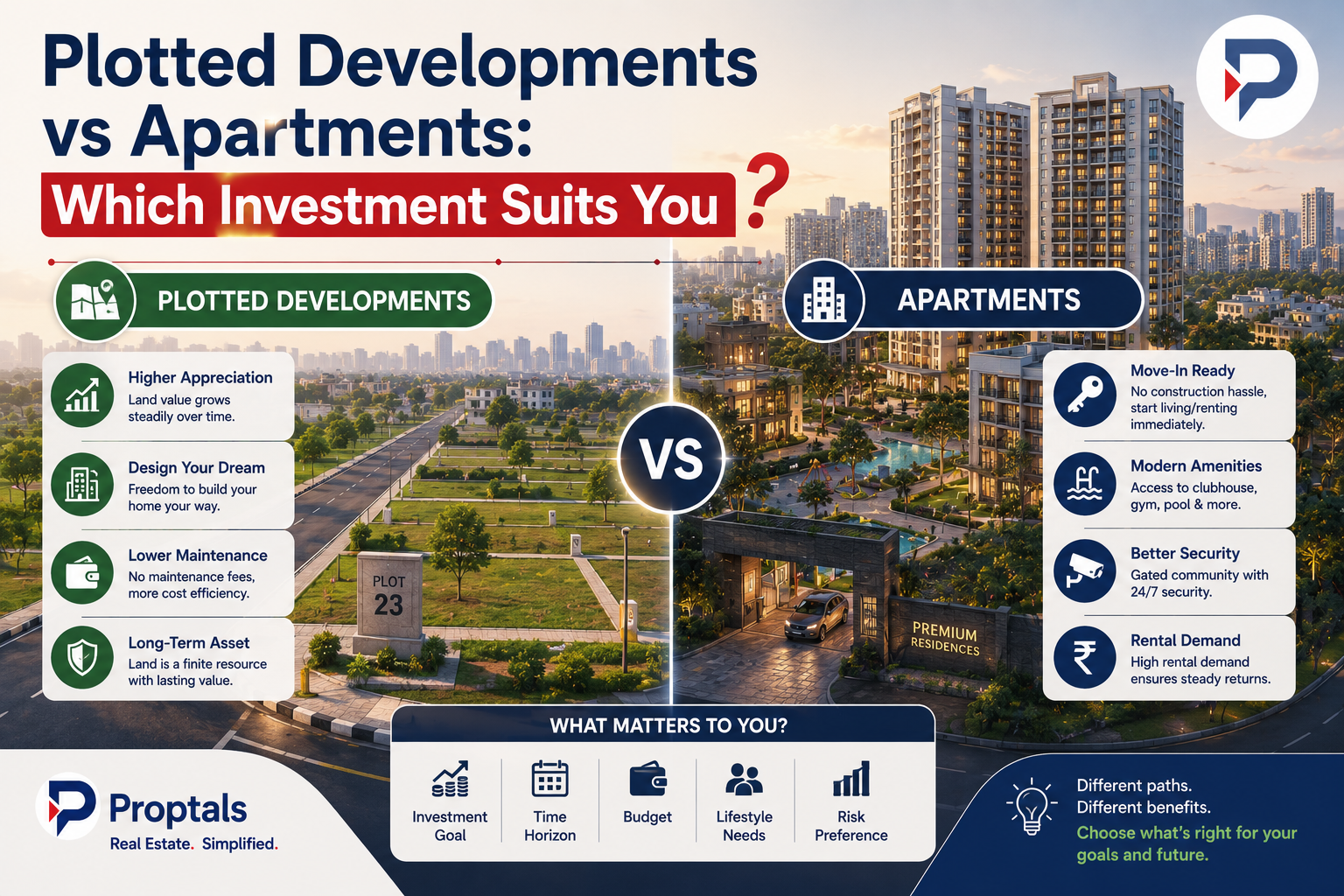
Plots tend to appreciate faster and give you freedom to build; apartments give you rent, amenities and security from day one. How the two compare in Bengaluru on returns, risk, liquidity and paperwork, and how to choose.

Tariq Sallam
By Tariq Sallam, founder of Proptals
Jul 21, 2026 · Updated Oct 1, 2026
6 min read

KEY TAKEAWAYS

  • Land appreciates; buildings depreciate. A plot's value is almost all land, so plots in growing corridors have historically appreciated faster than apartments in the same area.
  • Apartments earn rent from day one; an empty plot earns nothing and still needs to be protected and maintained.
  • Plots carry more paperwork risk: conversion, layout approval and title need careful checking. In plotted developments, buy only RERA-registered, approved layouts.
  • Apartments are generally easier to get a loan on and easier to resell quickly; plots can take longer to sell.
  • Choose a plot if you have a long horizon and want to build; choose an apartment if you want rent, amenities or a home to live in soon.

Many of my clients come in with a clear view: 'land never loses value' or 'apartments are safer'. Both statements have some truth in Bengaluru, and both have led people into poor decisions.

This guide compares plots and apartments on the things that actually decide returns and risk: appreciation, income, costs, liquidity, loans and paperwork. Then it suggests how to choose for your own situation.

How Plots and Apartments Make Money

An apartment's price is part land and part building. The land share is your undivided share of the plot the tower stands on, which is small in a high-rise. The building ages and depreciates. So an apartment's long-term appreciation depends heavily on the location and on how well the building is maintained.

A plot's price is almost entirely land. In a corridor where demand is growing, with new jobs, roads, metro lines or an airport, land values can rise strongly. That is why North Bengaluru, Sarjapur Road and the areas along new transport projects have seen intense interest in plotted developments.

But a plot earns no rent unless you build on it, and it can sit in a corridor that takes far longer to develop than the brochure suggested.

Side-by-Side Comparison

FactorPlotApartment
Long-term appreciationOften higher in growing corridorsModerate; depends on location and building upkeep
Rental incomeNone until you buildFrom day one
Upfront cost per sq ft of useLower to enter, but construction is extraHigher, but ready to live in or rent
Ongoing costsLow: tax, fencing, occasional clearingMaintenance charges, tax, repairs
Home loanPlot loans are available but more limited; construction loans followWidely available
LiquidityCan take longer to sellUsually quicker to sell in established areas
FlexibilityBuild what you want, when you wantFixed layout; limited changes
Security and amenitiesDepends on the layout; gated plotted developments helpSecurity, clubhouse, power backup in most projects
Paperwork riskHigher: conversion, layout approval, encroachmentLower in RERA projects with OC, but check title

When a Plot Makes More Sense

  • You have a long horizon, seven to ten years or more, and do not need rental income.
  • You plan to build your own home eventually, designed the way you want.
  • You are buying in a corridor with real, funded infrastructure coming, not just announced plans.
  • You want low holding costs and do not want to deal with tenants or maintenance.
  • You are prepared to do thorough due diligence, or have someone who will.

When an Apartment Makes More Sense

  • You want to live in it soon or rent it out for income.
  • You value security, power backup, water management and amenities.
  • You want a property that is easier to finance and easier to sell.
  • You are buying in an established area where land is scarce and plots are rare or very expensive.
  • You live abroad and want something simpler to manage remotely.

The Paperwork Risk With Plots, and How to Manage It

Most problems with plots around Bengaluru come from paperwork, not from the market. Before you buy a plot, a lawyer should confirm:

  1. Title and the chain of ownership back over a long period, including inheritance and partition.
  2. Land conversion: if the land was agricultural, it must have been legally converted for residential use.
  3. Layout approval by the right planning authority for the area, with the plot shown on the approved layout.
  4. RERA registration for plotted developments of the size that requires it, with the project's details checked on the Karnataka RERA site.
  5. E-khata in the seller's name, through e-Aasthi in the city or e-Swathu in panchayat areas.
  6. No acquisition notifications or road-widening plans affecting the plot.
  7. Physical checks: boundaries match the survey sketch, the plot is accessible, and there is no encroachment.

Be especially careful with very cheap plots in unapproved layouts, plots sold only on 'GPA' or agreement without registration, and 'farm plots' marketed as investments. NRIs cannot buy agricultural land at all. Our guide to A-khata and B-khata explains why approvals matter for resale.

Costs to Budget For

For a plot, budget for stamp duty and registration, legal checks, fencing, and eventually construction, which is a project in its own right. Construction loans are released in stages as the building progresses.

For an apartment, budget for stamp duty and registration, GST if under construction, interiors, maintenance deposits and the corpus fund, and monthly maintenance.

Building on Your Plot Later: What to Plan For

If you buy a plot to build a home, the plot is only the first step. Building requires an approved building plan from the right authority, adherence to setbacks and floor area rules, a reliable contractor and careful supervision. Construction in Bengaluru for an independent home typically takes many months to more than a year, depending on size and finishes.

Budget for the design fees, plan approval, construction, utility connections, compound walls and landscaping, and a contingency. Construction loans release money in stages as the building progresses, so you need cash for the gaps. Our partner network includes vetted contractors if you want introductions.

If you are buying in a plotted development, check whether the developer imposes design guidelines, how long you have to build, and whether there are maintenance charges for common areas while the plot is empty.

Plotted Developments vs Standalone Plots

Gated plotted developmentStandalone plot
ApprovalsLayout approved for the whole project; RERA registration where requiredMust be checked individually
InfrastructureRoads, drainage, water, power and security provided by the developerDepends on the area
PriceUsually higher per sq ftCan be lower
Paperwork riskLower if the developer is reputable and RERA-registeredHigher; needs careful individual checks
ResaleOften easier, especially in well-run communitiesDepends heavily on location and documents

For most buyers, especially NRIs and first-time plot buyers, a well-documented gated plotted development from a developer with a delivery record is the lower-risk way to own land.

A Balanced Approach

Several of my clients hold both: an apartment they live in or rent out for steady income and convenience, and a well-documented plot in a growth corridor as a long-term holding. The apartment covers today; the plot is for the next decade. If you can only do one, start with what fits your next five years, not with what sounds like the better investment in general.

Frequently Asked Questions

Do plots appreciate faster than apartments in Bangalore?

In growing corridors, plots have often appreciated faster because their value is almost entirely land. But plots earn no rent and carry more paperwork risk, so total returns depend on the specific plot and holding period.

Can I get a home loan for a plot?

Many lenders offer plot loans for approved residential plots, usually with stricter terms than apartment loans. Composite loans that cover the plot and construction are also available.

What approvals should a plot in Bangalore have?

Clear title, land conversion if it was agricultural, approved layout from the right planning authority, RERA registration for qualifying plotted developments, and an e-khata in the seller's name.

Can NRIs buy plots in Bangalore?

NRIs can buy residential plots in approved layouts. They cannot buy agricultural land, plantations or farmhouses, except by inheritance or gift.

Which is easier to resell, a plot or an apartment?

Apartments in established areas usually sell faster. Plots can take longer, especially in corridors that are still developing.

The better investment is the one that matches your timeline, your need for income and your appetite for paperwork. If you are weighing a specific plot or apartment, send me the details and I will tell you what I would check first.

Sources

Last updated Oct 1, 2026. Figures and rules change; check current details with a professional before you act.

Share this post:
Tariq Sallam, Founder of Proptals
ABOUT THE AUTHOR
Tariq Sallam
Founder, Proptals · Karnataka RERA registered agent

Tariq has advised buyers, sellers, landlords, landowners and developers in Bangalore since 2004. He writes about what he sees on site visits, in negotiations and at registration offices.

ASK TARIQ ON WHATSAPP
Plots vs Apartments in Bangalore: Which Investment Suits You? | Proptals Blog
Home  >  Blog  >  Investment
Plots vs Apartments in Bangalore: Which Investment Suits You?
INVESTMENT

Plots vs Apartments in Bangalore: Which Investment Suits You?

Plots tend to appreciate faster and give you freedom to build; apartments give you rent, amenities and security from day one. How the two compare in Bengaluru on returns, risk, liquidity and paperwork, and how to choose.

Tariq Sallam
By Tariq Sallam, founder of Proptals
Jul 21, 2026 · Updated Oct 1, 2026
6 min read

KEY TAKEAWAYS

  • Land appreciates; buildings depreciate. A plot's value is almost all land, so plots in growing corridors have historically appreciated faster than apartments in the same area.
  • Apartments earn rent from day one; an empty plot earns nothing and still needs to be protected and maintained.
  • Plots carry more paperwork risk: conversion, layout approval and title need careful checking. In plotted developments, buy only RERA-registered, approved layouts.
  • Apartments are generally easier to get a loan on and easier to resell quickly; plots can take longer to sell.
  • Choose a plot if you have a long horizon and want to build; choose an apartment if you want rent, amenities or a home to live in soon.

Many of my clients come in with a clear view: 'land never loses value' or 'apartments are safer'. Both statements have some truth in Bengaluru, and both have led people into poor decisions.

This guide compares plots and apartments on the things that actually decide returns and risk: appreciation, income, costs, liquidity, loans and paperwork. Then it suggests how to choose for your own situation.

How Plots and Apartments Make Money

An apartment's price is part land and part building. The land share is your undivided share of the plot the tower stands on, which is small in a high-rise. The building ages and depreciates. So an apartment's long-term appreciation depends heavily on the location and on how well the building is maintained.

A plot's price is almost entirely land. In a corridor where demand is growing, with new jobs, roads, metro lines or an airport, land values can rise strongly. That is why North Bengaluru, Sarjapur Road and the areas along new transport projects have seen intense interest in plotted developments.

But a plot earns no rent unless you build on it, and it can sit in a corridor that takes far longer to develop than the brochure suggested.

Side-by-Side Comparison

FactorPlotApartment
Long-term appreciationOften higher in growing corridorsModerate; depends on location and building upkeep
Rental incomeNone until you buildFrom day one
Upfront cost per sq ft of useLower to enter, but construction is extraHigher, but ready to live in or rent
Ongoing costsLow: tax, fencing, occasional clearingMaintenance charges, tax, repairs
Home loanPlot loans are available but more limited; construction loans followWidely available
LiquidityCan take longer to sellUsually quicker to sell in established areas
FlexibilityBuild what you want, when you wantFixed layout; limited changes
Security and amenitiesDepends on the layout; gated plotted developments helpSecurity, clubhouse, power backup in most projects
Paperwork riskHigher: conversion, layout approval, encroachmentLower in RERA projects with OC, but check title

When a Plot Makes More Sense

  • You have a long horizon, seven to ten years or more, and do not need rental income.
  • You plan to build your own home eventually, designed the way you want.
  • You are buying in a corridor with real, funded infrastructure coming, not just announced plans.
  • You want low holding costs and do not want to deal with tenants or maintenance.
  • You are prepared to do thorough due diligence, or have someone who will.

When an Apartment Makes More Sense

  • You want to live in it soon or rent it out for income.
  • You value security, power backup, water management and amenities.
  • You want a property that is easier to finance and easier to sell.
  • You are buying in an established area where land is scarce and plots are rare or very expensive.
  • You live abroad and want something simpler to manage remotely.

The Paperwork Risk With Plots, and How to Manage It

Most problems with plots around Bengaluru come from paperwork, not from the market. Before you buy a plot, a lawyer should confirm:

  1. Title and the chain of ownership back over a long period, including inheritance and partition.
  2. Land conversion: if the land was agricultural, it must have been legally converted for residential use.
  3. Layout approval by the right planning authority for the area, with the plot shown on the approved layout.
  4. RERA registration for plotted developments of the size that requires it, with the project's details checked on the Karnataka RERA site.
  5. E-khata in the seller's name, through e-Aasthi in the city or e-Swathu in panchayat areas.
  6. No acquisition notifications or road-widening plans affecting the plot.
  7. Physical checks: boundaries match the survey sketch, the plot is accessible, and there is no encroachment.

Be especially careful with very cheap plots in unapproved layouts, plots sold only on 'GPA' or agreement without registration, and 'farm plots' marketed as investments. NRIs cannot buy agricultural land at all. Our guide to A-khata and B-khata explains why approvals matter for resale.

Costs to Budget For

For a plot, budget for stamp duty and registration, legal checks, fencing, and eventually construction, which is a project in its own right. Construction loans are released in stages as the building progresses.

For an apartment, budget for stamp duty and registration, GST if under construction, interiors, maintenance deposits and the corpus fund, and monthly maintenance.

Building on Your Plot Later: What to Plan For

If you buy a plot to build a home, the plot is only the first step. Building requires an approved building plan from the right authority, adherence to setbacks and floor area rules, a reliable contractor and careful supervision. Construction in Bengaluru for an independent home typically takes many months to more than a year, depending on size and finishes.

Budget for the design fees, plan approval, construction, utility connections, compound walls and landscaping, and a contingency. Construction loans release money in stages as the building progresses, so you need cash for the gaps. Our partner network includes vetted contractors if you want introductions.

If you are buying in a plotted development, check whether the developer imposes design guidelines, how long you have to build, and whether there are maintenance charges for common areas while the plot is empty.

Plotted Developments vs Standalone Plots

Gated plotted developmentStandalone plot
ApprovalsLayout approved for the whole project; RERA registration where requiredMust be checked individually
InfrastructureRoads, drainage, water, power and security provided by the developerDepends on the area
PriceUsually higher per sq ftCan be lower
Paperwork riskLower if the developer is reputable and RERA-registeredHigher; needs careful individual checks
ResaleOften easier, especially in well-run communitiesDepends heavily on location and documents

For most buyers, especially NRIs and first-time plot buyers, a well-documented gated plotted development from a developer with a delivery record is the lower-risk way to own land.

A Balanced Approach

Several of my clients hold both: an apartment they live in or rent out for steady income and convenience, and a well-documented plot in a growth corridor as a long-term holding. The apartment covers today; the plot is for the next decade. If you can only do one, start with what fits your next five years, not with what sounds like the better investment in general.

Frequently Asked Questions

Do plots appreciate faster than apartments in Bangalore?

In growing corridors, plots have often appreciated faster because their value is almost entirely land. But plots earn no rent and carry more paperwork risk, so total returns depend on the specific plot and holding period.

Can I get a home loan for a plot?

Many lenders offer plot loans for approved residential plots, usually with stricter terms than apartment loans. Composite loans that cover the plot and construction are also available.

What approvals should a plot in Bangalore have?

Clear title, land conversion if it was agricultural, approved layout from the right planning authority, RERA registration for qualifying plotted developments, and an e-khata in the seller's name.

Can NRIs buy plots in Bangalore?

NRIs can buy residential plots in approved layouts. They cannot buy agricultural land, plantations or farmhouses, except by inheritance or gift.

Which is easier to resell, a plot or an apartment?

Apartments in established areas usually sell faster. Plots can take longer, especially in corridors that are still developing.

The better investment is the one that matches your timeline, your need for income and your appetite for paperwork. If you are weighing a specific plot or apartment, send me the details and I will tell you what I would check first.

Sources

Last updated Oct 1, 2026. Figures and rules change; check current details with a professional before you act.

Share this post:
Tariq Sallam, Founder of Proptals
ABOUT THE AUTHOR
Tariq Sallam
Founder, Proptals · Karnataka RERA registered agent

Tariq has advised buyers, sellers, landlords, landowners and developers in Bangalore since 2004. He writes about what he sees on site visits, in negotiations and at registration offices.

ASK TARIQ ON WHATSAPP