

KEY TAKEAWAYS
- A final e-khata has been mandatory for registering property in Bengaluru since October 2024. A draft e-khata is not enough.
- Since September 2025, Bengaluru's civic records are managed under the Greater Bengaluru Authority and its city corporations. Urban e-khatas are issued through the e-Aasthi system; village panchayat properties use e-Swathu.
- The e-khata must be in the seller's exact name, match the sale deed, and show the correct site and built-up area.
- A-khata and B-khata are not the same. B-khata properties have irregularities that can affect loans, approvals and resale.
- The e-khata is one document among several. Title, encumbrance certificate, approvals, tax receipts and a lawyer's opinion still matter.
Here is a situation that plays out across Bengaluru far too often. The bank has approved the loan, the seller has signed the agreement, the money is ready, and the registration appointment is two days away. Then the sub-registrar's system refuses the registration because the seller has only a draft e-khata. Everything stops until it is fixed, which can take weeks.
Property records here have moved online, and the rules about what you need to register a sale are now enforced by software, not by discretion. This guide explains what the e-khata is, what to check, and how to avoid finding out about a problem at the last minute.
What a Khata Is, and Why It Went Digital
A khata is the civic body's record of a property. It identifies the property, its owner, its size and its use, and it is the basis for property tax. It is not a title document: it does not prove ownership by itself. But without it you cannot pay tax in your name, apply for building permissions, get utility connections easily, or, since October 2024, register a sale.
For decades, khata records in Bengaluru were kept on paper and in separate databases that did not always agree with each other or with the land records. The state moved them online so that the sub-registrar's registration system can check, automatically, that the property being sold exists in the civic records and belongs to the person selling it. The digital record is the e-khata.
In September 2025, Bengaluru's civic administration was reorganised under the Greater Bengaluru Authority (GBA), with five city corporations below it. If you see older documents and guides referring to BBMP, that is the former single corporation. The e-khata system carried on through the change, but it is one more reason older paperwork sometimes needs updating.
Draft E-Khata vs Final E-Khata
This is the distinction that catches people out.
| Draft e-khata | Final e-khata | |
|---|---|---|
| What it is | A record generated from existing property tax and khata data | The confirmed record after the owner's details are verified |
| How it is created | Automatically from old records | Owner completes Aadhaar e-KYC, uploads documents and pays any charges |
| Accepted for registration? | No | Yes |
| What to do | Ask the owner to convert it to final | Download it, check every detail, keep a copy |
If you are buying, ask for the final e-khata at the very start, before you pay a token. If you are selling, apply for it before you put the property on the market. The time it takes varies, and a pending e-khata is one of the most common reasons registrations get pushed back.
Which Portal: e-Aasthi or e-Swathu?
Properties within Bengaluru's city corporation limits get their e-khata through e-Aasthi, the urban property records system. Properties in village panchayat areas, which includes many layouts on the city's edges, are recorded in e-Swathu, the rural system.
This matters when you buy on the outskirts. A plot in a growing area off Sarjapur Road, Hoskote or Devanahalli may still fall under a panchayat. Its records, approvals and the right authority to deal with will be different from a property in the city. Find out which system the property sits in before you start chasing documents.
A-Khata, B-Khata, and Why It Matters
You will still hear people talk about A-khata and B-khata properties.
- A-khata is the regular record for properties that are legally approved: correct land conversion, an approved layout or building plan, and taxes paid.
- B-khata was created to bring properties with irregularities into the tax net, such as sites in unapproved layouts, buildings that deviate from plans, or land without proper conversion. Owning a B-khata property does not make it illegal to live in, but it limits what you can do.
B-khata properties can be harder to get a home loan on, harder to obtain building permissions for, and harder to resell at full value. The government has run schemes to convert eligible B-khata properties to A-khata, including a window with reduced charges in 2026. Conversion generally requires the property to meet the underlying rules and the owner to pay the prescribed fees.
If you are offered a B-khata property at an attractive price, the discount is usually there for a reason. Have a lawyer tell you exactly what the irregularity is, whether it can be regularised, and at what cost, before you decide.
What to Check on the E-Khata Itself
When the seller shares the final e-khata, do not just confirm it exists. Read it.
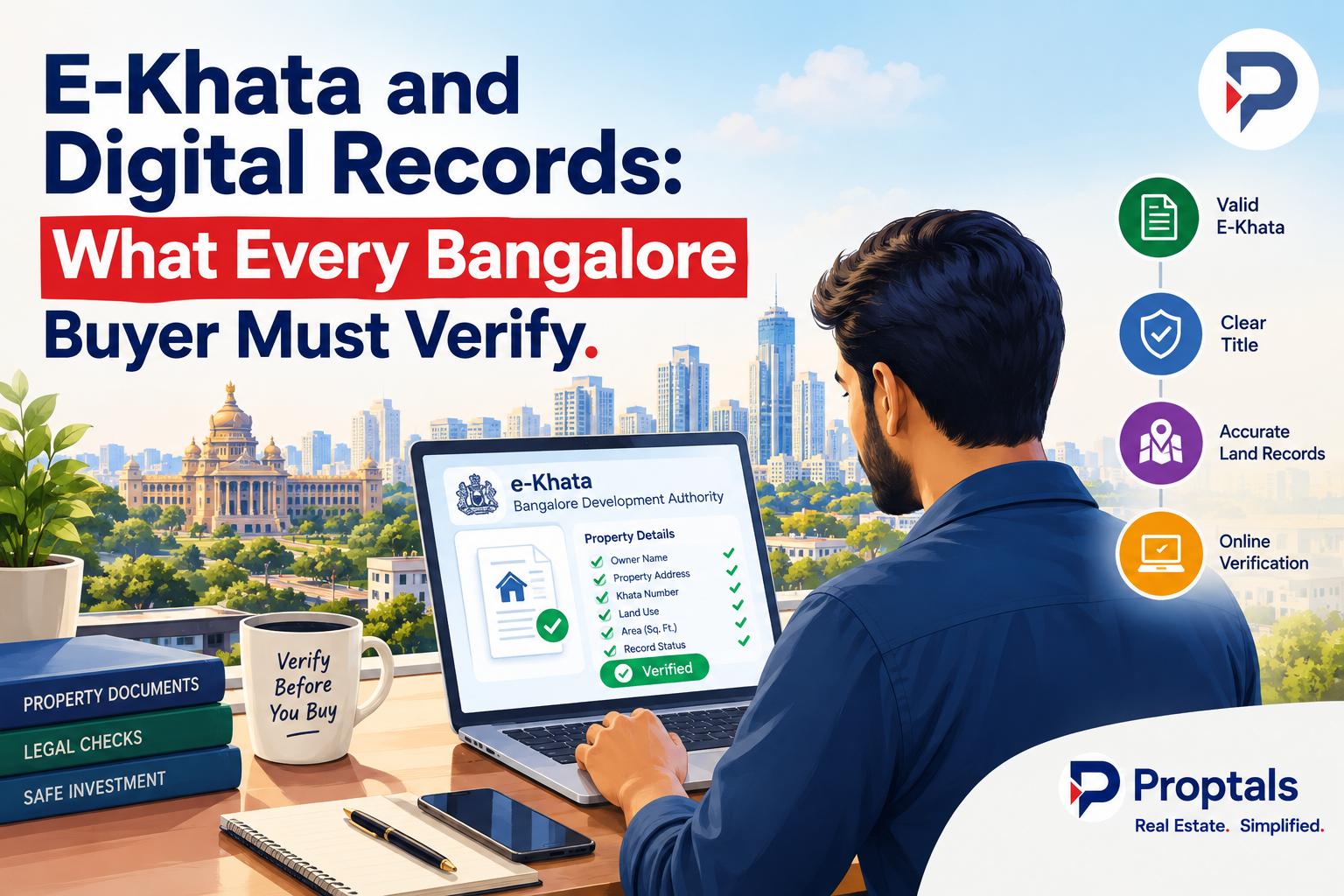
- Owner's name matches the sale deed and the seller's ID exactly. Joint owners should all appear.
- Property identification: the property ID and address match the sale deed and the tax receipts.
- Site area and built-up area match the sale deed and, for apartments, the undivided share and the unit's area in the agreement.
- Property use: residential or commercial, matching how it is actually used.
- Tax status: no arrears. Ask for recent tax receipts as well.
- For apartments: the e-khata is for the individual unit, not just the building. Bifurcated khatas are needed for each flat.
If anything does not match, stop and get it corrected before you go further. A mismatch between the e-khata and the sale deed can block registration just as surely as a missing e-khata.
The Complete Document Checklist for a Bengaluru Purchase
The e-khata is necessary but not sufficient. These are the documents I ask for on every purchase, and what each one tells you.
| Document | What it tells you |
|---|---|
| Sale deed and previous title deeds | Who owns the property and how ownership passed over the years |
| Final e-khata | The civic record is in order and registration can go through |
| Encumbrance certificate (EC) | Mortgages, attachments and other registered transactions on the property |
| Property tax receipts | Taxes are paid up and the assessed details match |
| Approved building plan and occupancy certificate | What was allowed to be built, and confirmation that the building is complete and fit to occupy |
| Land conversion order | Agricultural land was legally converted for residential use (for plots and independent houses) |
| RERA registration | For under-construction projects: the project is registered and its progress is reported |
| Association or society no-dues | No pending maintenance charges that would pass to you |
| Loan closure and document release letter | If the seller had a loan, the bank has been paid and the originals released |
Encumbrance certificates and registration records can be obtained online through the state's Kaveri registration system. Read the EC for a long period, ideally thirty years for land and older properties. Older claims are the ones that surface at the worst time.
If You Are Selling: Get Ready Before You List
Sellers who prepare early sell faster and with fewer price negotiations. Before your property goes to market:
- Apply for or download your final e-khata, and check every detail on it.
- Pay any outstanding property tax and keep the receipts.
- Collect your sale deed, previous title deeds, approved plan, occupancy certificate and EC.
- If you had a home loan, get the closure letter and the original documents back from the bank.
- For apartments, get the association's no-dues certificate.
- If you live abroad, arrange a specific power of attorney well in advance.
A buyer's lawyer will ask for all of this anyway. Having it ready signals a clean property and makes it much harder for a buyer to use paperwork as a reason to push the price down. See how we sell premium homes.
Common Problems and How They Get Fixed
Name mismatch
Spelling differences between the khata, sale deed and ID documents are common, especially in older records. They are usually fixable with an application and supporting documents, but they take time. Find them early.
Area mismatch
The area in the tax records sometimes differs from the sale deed or the actual measured area. A survey and an application for correction may be needed.
Khata still in a previous owner's name
If the seller bought the property but never transferred the khata, the transfer has to happen before they can sell. Ask about this on day one.
Property in a panchayat area
The e-Swathu process and the approvals that apply are different. Make sure your lawyer knows the area.
Frequently Asked Questions
Is e-khata mandatory for property registration in Bengaluru?
Yes. Since October 2024, the registration system requires a final e-khata for properties in Bengaluru. Without it, the sale deed cannot be registered.
What is the difference between a draft e-khata and a final e-khata?
A draft e-khata is generated automatically from existing records. A final e-khata is issued after the owner completes Aadhaar e-KYC, submits documents and pays any charges. Only the final e-khata is accepted for registration.
Is e-khata proof of ownership?
No. It is a civic and tax record. Ownership is proved by the registered sale deed and the chain of title. Always have a lawyer check title separately.
Can I get a home loan on a B-khata property?
It is often difficult. Many lenders are reluctant to lend on B-khata properties because of the underlying irregularities. Check with your bank before you commit.
Where do I apply for an e-khata in Bengaluru?
Properties in the city corporations' limits use the e-Aasthi system. Properties in village panchayat areas use e-Swathu.
How long does it take to get a final e-khata?
It varies with the property and how clean the existing records are. Apply as early as possible, and do not fix a registration date until you have it.
The move to e-khata has made Bengaluru property transactions more transparent, and that is good for buyers. But it has also made last-minute surprises more expensive. Check early, read every document, and do not fix a registration date until the final e-khata is in hand. If you would like me to look over a property's documents before you commit, message me on WhatsApp.
Sources
- Sobha: Why e-khata is mandatory in Bangalore (Sept 2026)
- Sobha: A-khata vs B-khata vs e-khata
- Kotak: Stamp duty and registration charges in Karnataka
- Karnataka e-Aasthi portal
- Kaveri Online Services (registration and EC)
Last updated Oct 1, 2026. Figures and rules change; check current details with a professional before you act.