
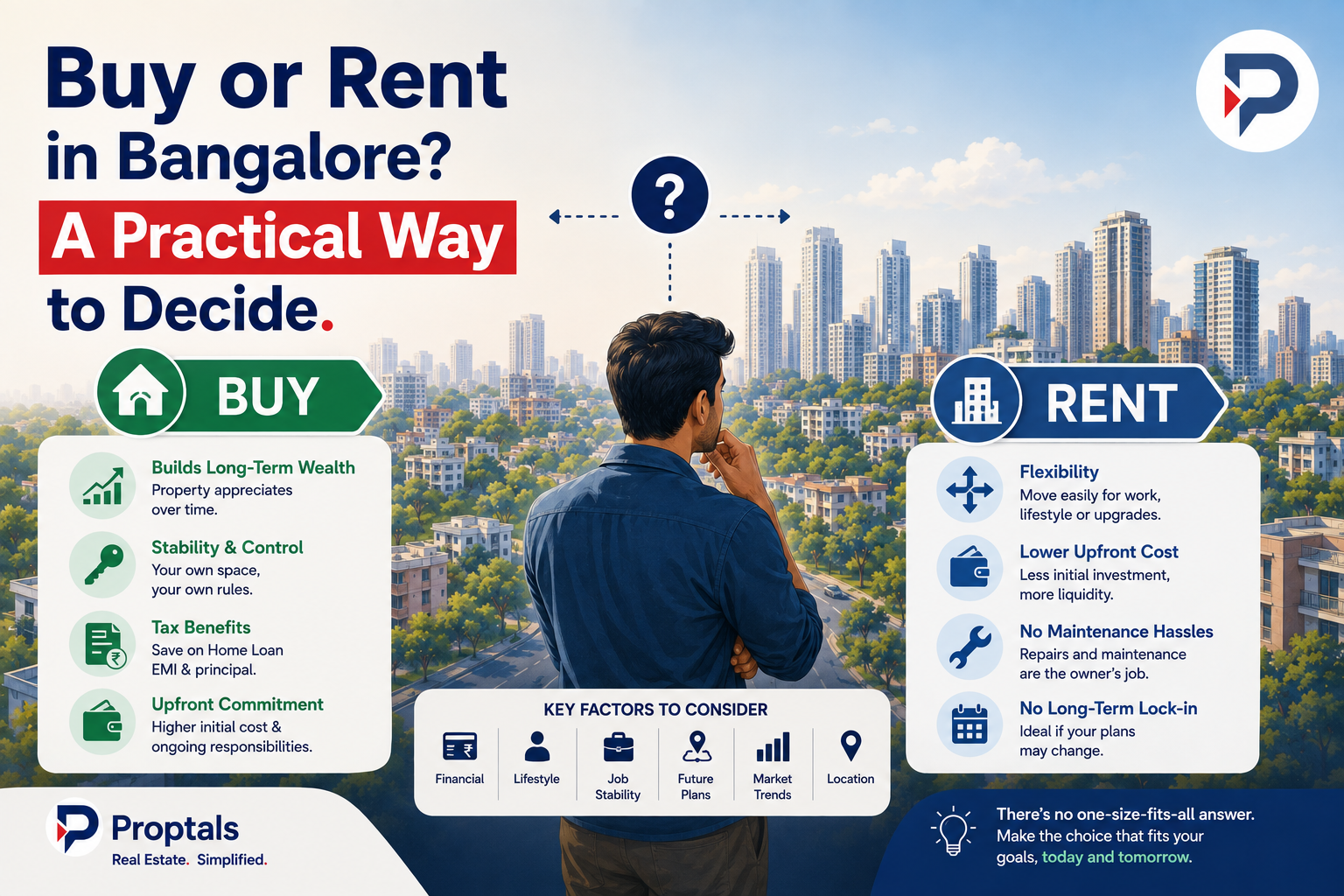

KEY TAKEAWAYS
- In Bengaluru, rent is typically 3% to 4% of a home's value per year, while buying adds stamp duty, registration, interest and maintenance. Renting often costs less in the short run.
- Buying makes sense when you expect to stay seven years or more, have a stable income, and can make the down payment without draining your emergency fund.
- Budget about 6% on top of the price for stamp duty and registration on most premium homes, plus GST if the home is under construction.
- The question is not 'rent or own' but 'what will I do with the money I don't put into a house'. Renting only wins if the difference is actually invested.
- Life factors often matter more than numbers: job stability, children's schooling, and whether you might move cities.
Few questions start more arguments at family dinners in Bengaluru than this one. Parents tend to see rent as money thrown away; younger professionals look at the EMI and wonder why they would lock themselves in.
Both views have a point, and neither is a rule. Here is how I help clients think it through, with the actual costs of buying in Bengaluru, a simple comparison method, and the personal factors that usually decide it.
Start With the Real Cost of Each Option
The cost of renting
Renting costs you the rent, the security deposit tied up with the landlord, brokerage when you move, and moving costs every few years. In Bengaluru, annual rent is usually around 3% to 4% of what the same home would cost to buy.
The cost of owning
Owning costs more than the EMI. It includes:
- Stamp duty and registration: in Karnataka, 5% stamp duty for homes above ₹45 lakh plus a 1% registration fee.
- GST on under-construction homes, charged by the developer.
- Interest on the home loan, which in the early years is most of each EMI.
- The return you give up on the down payment, which could otherwise be invested.
- Maintenance charges, property tax, insurance and repairs.
- Interiors for a new or bare home, which are easy to underestimate.
Against this, owning gives you something renting never does: capital growth on the property, and protection from rent increases.
A Simple Way to Compare
Rather than a complicated spreadsheet, start with these three questions.
- How long will you stay? Buying and selling cost a lot in fees and stamp duty. Over three or four years, those costs usually outweigh any price growth. Over seven to ten years, they are spread thin enough to matter less.
- What is the price-to-rent ratio? Divide the price by the annual rent for a similar home. If a ₹1.5 crore flat rents for ₹45,000 a month (₹5.4 lakh a year), the ratio is about 28. The higher the ratio, the more renting favours you financially in the short term.
- Will you invest the difference? If renting is cheaper than owning each month, renting only comes out ahead if you actually invest the savings and the down payment. Most people who 'rent and invest the rest' do not invest the rest.
| Illustration (₹1.5 crore home) | Buy | Rent |
|---|---|---|
| Upfront cash | Down payment plus about ₹9 lakh stamp duty and registration, plus interiors | Deposit and brokerage |
| Monthly outflow | EMI plus maintenance | Rent |
| After 10 years | You own an asset that may have grown in value; the loan is partly repaid | You own whatever you invested from the savings |
| Flexibility | Low: selling takes time and costs money | High: move with a few months' notice |
The illustration is deliberately simple. A financial planner can model your exact numbers, including tax benefits on home loan interest and principal, which change the answer for some buyers.
When Buying Makes More Sense
- You expect to stay in Bengaluru, and ideally in the same part of the city, for seven years or more.
- Your income is stable and the EMI is comfortably below about a third of your take-home pay.
- You can make the down payment and pay stamp duty without emptying your emergency fund.
- You want stability: no landlord deciding not to renew, no moving every few years, freedom to renovate.
- You are buying in a location with genuine long-term demand, such as good job access, metro connectivity and reliable water.
When Renting Makes More Sense
- You might change jobs or cities in the next few years.
- You are new to Bengaluru and do not yet know which area suits your work, schools and lifestyle.
- The home you would want to buy is far more expensive than renting the same home, and you will invest the difference.
- Your income is variable, or you would need to stretch to afford the EMI.
- You are waiting for a specific project or area to mature, such as a metro line actually opening.
Renting first, for a year or two, is often the smartest move for families relocating to Bengaluru. You learn the city before committing to it.
Mistakes That Make Either Choice Expensive
- Buying at the very top of your budget, leaving no room for interiors, emergencies or a rate rise.
- Buying an under-construction home you will need in two years, when completion may take longer.
- Renting 'to invest the difference' and never investing it.
- Choosing a home for its price per square foot rather than its commute, water and resale potential.
- Ignoring stamp duty, registration and interiors when comparing options.
Tax Benefits: How They Change the Maths
Home loans carry tax benefits that renting does not, and for some buyers they narrow the gap considerably. Under the tax rules that have applied for many years, interest on a home loan for a self-occupied home can be deducted up to a limit, and principal repayment can count towards investment deductions, depending on which tax regime you choose.
The catch is that the newer default tax regime does not allow most of these deductions for self-occupied homes, and India's tax law was rewritten into the Income-tax Act, 2025 from April 2026. Whether you benefit depends on the regime you choose and your income. Ask a chartered accountant to run your numbers both ways before you count on tax savings.
Renters, meanwhile, may be able to claim house rent allowance (HRA) if their salary includes it, again depending on the tax regime. The point is the same: tax can tip the balance, but only after you check your own situation.
The Hidden Costs Buyers Forget
- Interiors: a bare or new apartment can need a substantial budget for wardrobes, kitchen, lighting and furnishing.
- Corpus and deposits: many projects collect a corpus fund and advance maintenance at possession.
- Parking and club charges in some projects, if not included in the price.
- Loan processing and legal fees, and the bank's valuation charges.
- Moving costs and the time off work to manage registration, interiors and the move.
- Annual costs: property tax, maintenance, insurance and repairs, which rise over time.
None of these are reasons not to buy. They are reasons to budget properly, so that the purchase does not leave you stretched in the first two years.
A Worked Ten-Year Comparison (Illustrative)
Imagine a ₹1.5 crore home that rents for ₹45,000 a month. Buyer A puts down ₹40 lakh including stamp duty and registration, and takes a loan for the rest. Renter B rents the same home and invests the ₹40 lakh and the monthly difference between the EMI plus maintenance and the rent.
Over ten years, Buyer A's outcome depends mainly on how much the home appreciates. Renter B's depends on the returns on their investments and whether they actually kept investing every month. If the property grows strongly and B invests inconsistently, A comes out well ahead. If the property grows slowly and B invests diligently in a diversified portfolio, B can match or beat A.
This is why there is no universal answer. The comparison turns on two things you control, how long you stay and whether you invest the difference, and one you do not, how the specific property appreciates.
A Middle Path Many Families Choose
Some clients buy a home in an area with strong rental demand, rent it out, and continue renting where they live for work or schooling reasons. The rent covers part of the EMI, the property builds equity, and the family keeps its flexibility. It is not right for everyone, and it needs careful planning for tax and management, but it is worth considering if you want to own without being tied to one location.
Frequently Asked Questions
Is it better to buy or rent in Bangalore in 2026?
It depends on how long you will stay, your income stability and whether you would invest the money you save by renting. As a rough guide, buying tends to make more sense if you will stay seven years or more.
How much do stamp duty and registration cost in Bangalore?
For homes above ₹45 lakh, stamp duty in Karnataka is 5% of the property value and the registration fee is 1%. Under-construction homes also attract GST.
What is a good price-to-rent ratio?
There is no universal number, but the higher the ratio of price to annual rent, the more renting favours you financially in the short term. In Bengaluru, ratios are often between 25 and 35.
Should I buy an under-construction or ready home?
A ready home with an occupancy certificate has no construction risk and no GST. An under-construction home may cost less but carries delivery risk. Check the developer's RERA record carefully.
Can I rent out the home I buy and keep renting myself?
Yes, many people do. The rent offsets part of the EMI. Take tax advice, because the treatment of home loan benefits differs for let-out property.
There is no universally right answer, only the right answer for your situation. If you would like to talk through your numbers, or see what your budget buys in the areas you are considering, send me a message.
Sources
- Kotak: Stamp duty and registration charges in Karnataka
- Rent vs Buy India: Average rental yields by city (2026)
- JLL: Bengaluru residential market dynamics Q2 2026
Last updated Oct 1, 2026. Figures and rules change; check current details with a professional before you act.